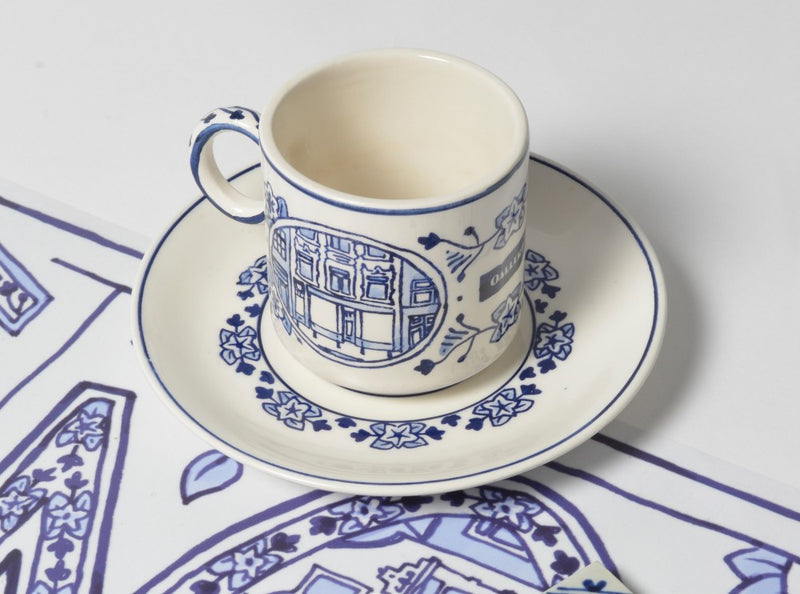


Making bisque earthenware with casting slip is not something that comes to mind first when you think of ceramics, you quickly picture someone working with clay on a potter’s wheel. But in the production of Delftware, it works differently. Instead of wheel-throwing by hand, we use liquid clay, also called casting slip. With it, we can create clean, precise shapes with a lot of detail, and exactly that is important for Delft and Gouda earthenware. In this blog, we explain how the casting process works and how a fragile clay piece eventually turns into sturdy bisque earthenware, ready for decoration.
Liquid clay and plaster molds
During casting, liquid clay is poured into a plaster mold. That mold will determine the shape of the product. The plaster then does something important: it is very porous and draws the moisture out of the clay. This leaves a layer of clay on the inside of the mold. The longer you let the clay sit, the thicker that layer becomes. This is useful, for example, when you want to create a thicker rim.
We also make our plaster molds in-house. Would you like to know more about why such a mold is so important in the process? In our earlier blog, we explain it in detail: The role of a plaster mold in ceramics!
This is how the “crust” forms in the mold
Once the right thickness has been reached, we pour the excess clay back out of the mold. What remains is a kind of “crust” on the inside. It then needs to dry for a while, so the piece becomes sturdy enough to remove from the mold. This process sounds simple, but it is a matter of timing. Releasing too early can cause deformation, and too late means the piece is harder to remove from the mold.
In short, this is what happens during casting:
- Liquid clay goes into the plaster mold
- The plaster draws moisture out of the clay
- A layer of clay forms against the inside
- The rest of the clay is poured out
- After drying, the product can be removed from the mold
Molds in one part or multiple parts
Not every shape is equally easy to release. Simple molds sometimes consist of one part, such as with a round bowl. But as soon as a shape becomes more complex, you need multiple mold parts to remove the product from the mold without damage. In our workshop, we also make these molds ourselves, so we can maintain control over quality and details.
For some shapes, that number increases significantly. Our most complex shape is a tulip vase that consists of no fewer than 16 parts. That clearly shows how much craftsmanship is behind the casting process, even before a single brush is involved.
Finishing the “green clay”
When the product comes out of the plaster mold, it is still fragile. At this stage, we also call it “green clay.” It already has the right shape, but it is not yet smooth and neatly finished. That is why we first remove the seams and imperfections. We do this with a scraping knife and later with a small sponge, so the surface becomes nice and clean.
This finishing usually consists of:
- Removing seams from the mold parts
- Smoothing out imperfections
- Neatly refining edges and details
- Checking whether the product is clean and symmetrical
After that, the piece needs to continue drying slowly. Only when it is completely dry can it go into the kiln.
The first firing: from clay to bisque
After a few days of drying, the product is ready for the first firing. This takes place at a temperature of about 1020 degrees Celsius. During this firing, the fragile, soft clay turns into bisque earthenware. Bisque is sturdy, but still porous. That porosity is important, because it allows the piece to be properly decorated later before it is glazed.
From this moment on, the piece really starts to look like earthenware. The shape is final, the material is strong enough to handle, and it can move on to the next step in the process.
Kept in stock, so any decoration is possible later
We often keep bisque in stock as blank pieces. This means the product has been fully shaped and fired, but does not yet have any decoration. This allows us to respond quickly when an order comes in and still create any desired decoration later. This is useful for custom work, corporate gifts, or special requests.
In addition to the approximately 300 models in our webshop, we also have a much larger stock. Think of hundreds of extra shapes of tableware, figurines, animals, and tulip vases. Ceramic artists can also buy bisque from us to decorate themselves, for example if they want to work outside the fixed collection.
The journey of the Delftware continues
After casting, drying, finishing, and bisque firing, the work is not finished yet. This is only the beginning. Delftware is known precisely for decorating and glazing: the craftsmanship you ultimately see in the final product. The journey of the Delftware therefore continues after this to the decoration department, where the bisque is prepared for the painting work and the final glaze layer.