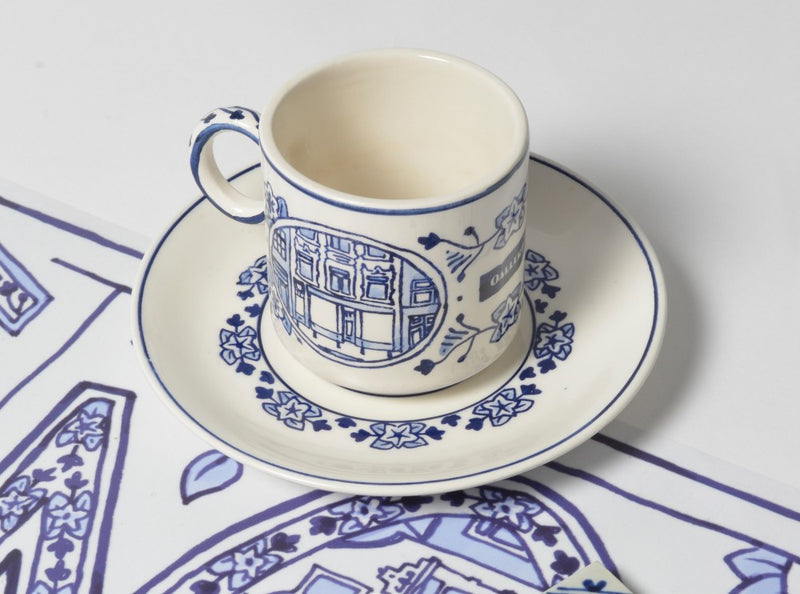
Skilled pottery painters aren’t easy to come by


Our family business was recently featured in the newspaper AD. The occasion was the 75th anniversary of Montagne Aardewerkfabriek/Dutchceramics. But the conversation also turned to a subject that is just as important for our future: finding skilled pottery painters.
As the interview with AD also made clear, skilled pottery painters aren’t easy to come by. It is a specialist craft, and fewer and fewer experienced craftspeople are available. Anyone wanting to learn the trade needs plenty of practice and, above all, hands-on experience.
That is why we train new pottery painters ourselves in our workshop in Gouderak. This not only enables us to continue the work, but also ensures that knowledge and experience are passed on.
A craft practiced by fewer and fewer people
The pottery industry in and around Gouda was once considerably larger. Over the years, the number of producers has declined significantly, and with it the number of people working with this craft on a daily basis.
We notice this particularly when looking for pottery painters. It is not a profession where experienced craftspeople are readily available. That is why we train new craftspeople ourselves in our workshop.
Pottery painting is a skill you learn primarily by doing. It starts with practising, learning to control the brush and painting simple decorations. From that foundation, a painter can gradually develop their skills further.
This takes time and guidance, but it is essential if we want to prevent this knowledge from disappearing.
Where hand-painted craftsmanship makes the difference
Not every piece of pottery needs to be painted entirely by hand. Within our production process, we use different decoration techniques depending on the product, the quantity and the desired appearance.
For special pieces and custom-made work, however, hand painting continues to play an important role. It is not simply about applying a decoration; the experience and skill of the painter are equally important.
A good example is the series of twelve replicas we recently made of a DAF anniversary plate from 1953. The aim was to recreate the original plate as accurately as possible. The painting alone required many hours of work. Achieving the right shades of blue, proportions and fine details demanded a great deal of care and attention.
Projects like this show just how much knowledge and skill go into a hand-painted ceramic piece.
Keeping knowledge in the workshop
At our factory in Gouderak, we carry out almost the entire production process ourselves. From making plaster moulds and casting the clay to firing, glazing and decorating.
This not only gives us control over the production process, but also allows us to retain knowledge of the different aspects of the craft within the company. New employees can learn from people who work with these techniques every day.
After 75 years, this may well be one of the most important conditions for continuing as a pottery manufacturer.
Moulds and tools can be preserved. Craftsmanship cannot. It only survives when people learn the craft, continue to practise it and pass their experience on to the next generation.